University of Oxford Annual Taiwan Studies Conference Examines Taiwan in the Indo-Pacific Context
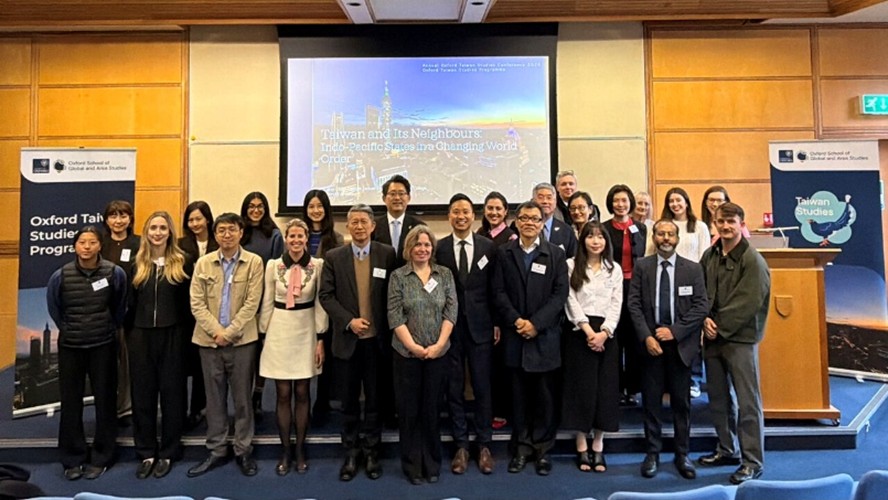
The Oxford Taiwan Studies Programme at the University of Oxford held its flagship Annual Oxford Taiwan Studies Conference on 14 May at the University of Oxford. It brought together scholars from Taiwan, the UK, Norway, Sweden, and New Zealand, reflecting the interdisciplinary and international character of Taiwan studies, and was attended by approximately 100 scholars, students, and policy stakeholders.
The theme of this year’s conference was Taiwan and Its Neighbours: Indo-Pacific States in a Changing World Order. The conference was organised into three panel sessions: Panel 1 was on US–China competition and Taiwan in the Indo-Pacific; Panel 2 was on Northeast Asia Theatre: Japan, Taiwan, and South Korea; and Panel 3 was on Other Indo-Pacific States: India, Vietnam, and New Zealand.
The speakers included Professor Tsai Chung-min 蔡中民, from the Department of Political Science at National Chengchi University; Associate Professor Lee Chun-yi 李淳怡, from the School of Politics and International Relations at the University of Nottingham, where she is director of the Taiwan Research Hub; and Professor Lu Yeh-chung 盧業中, Dean of the College of International Affairs at National Chengchi University, where he is a professor in the Department of Diplomacy, and vice president of the Taiwan Foundation for Democracy.
It began with welcoming remarks given by Dr. Jing Bo-jiun 荊柏鈞, a senior research fellow and programme manager of the Oxford Taiwan Studies Programme in the Oxford School of Global and Area Studies, and by Cheu-an Andy Bi, Director of the Education Division of the Taipei Representative Office in the UK. Dr. Jing stated that a principal objective of the conference was to situate Taiwan within a broader Indo-Pacific context beyond cross-strait relations, and to examine how regional actors are responding to rapid geopolitical change. The conference’s timing—amid heightened international attention on US–China relations and the visit to the UK by Han Kuo-yu 韓國瑜, president of Taiwan’s Legislative Yuan, and a cross-party delegation—underscored the urgency and significance of discussions on Taiwan and regional resilience.
Director Bi described Taiwan studies as a long-term investment in mutual understanding, as well as an academic initiative. Taiwan-related research enables scholars and students to engage with Taiwan, examining its democracy, society, history, culture, economics, and international relations, and this contributes to more balanced and nuanced perspectives. He pointed out that issues affecting Taiwan are closely connected to the future of the Indo-Pacific region, including regional security, democratic resilience, supply chains, technological development, and the international order. He said that the Ministry of Education remains committed to supporting the Oxford Taiwan Studies Programme, and to strengthening the academic foundations of Taiwan studies in the UK and globally, through international collaboration and training of people with expertise in the Taiwan studies field.
Each of the three panel presentations was followed by a Q&A and discussion. Professor Rachel Murphy from the Oxford School of Global and Area Studies gave the closing remarks.