Indian Institute of Technology Gandhinagar Delegation Visits Taiwan
Exchanges between Taiwan and India related to higher education, Mandarin language education, and research have grown significantly in the past decade, and there were 974 Indian students undertaking a doctoral degree program at a university in Taiwan in the 2025–2026 academic year.
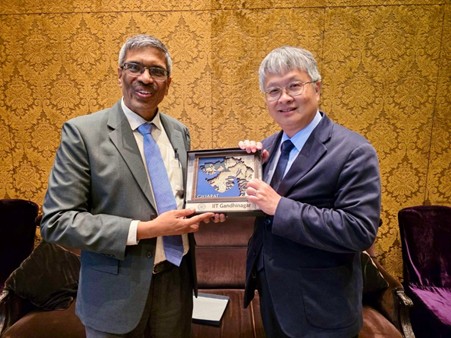
Prof. Rajat Moona, Director of the Indian Institute of Technology Gandhinagar (IIT Gandhinagar), led a delegation to Taiwan from September 20 to September 25, at the invitation of Taiwan’s Ministry of Education. During the delegation’s visit, separate memoranda of understanding were signed between IIT Gandhinagar and three universities in Taiwan—between IIT Gandhinagar and National Central University; between IIT Gandhinagar and National Taiwan University of Science and Technology; and between IIT Gandhinagar and National Taipei University of Technology. IIT Gandhinagar will strengthen cooperation related to semiconductors, artificial intelligence (AI), advanced engineering, and other cutting-edge fields with each of these three universities.
IIT Gandhinagar is located in Gujarat, where the Indian government is actively developing a semiconductor ecosystem, and it is playing an important role in semiconductor research, industry collaboration, and the development of a skilled workforce. With support from India’s Ministry of Electronics and Information Technology and the Government of Gujarat, IIT Gandhinagar established the Silicon and Advanced Semiconductor Manufacturing Research and Training Hub (SAMARTH) and launched programs such as Integrated Circuit Design and Technology (ICDT) to train professionals with advanced semiconductor skills.
The delegation visited five leading Taiwanese universities—National Cheng Kung University, National Yang Ming Chiao Tung University, National Taiwan University of Science and Technology, National Taipei University of Technology, and National Central University—and the Taiwan Semiconductor Research Center, and Powerchip Semiconductor Manufacturing Corporation (PSMC).