Primary and Secondary Schools in Taiwan and Belgium’s French-Speaking Community Hold First Online Exchange
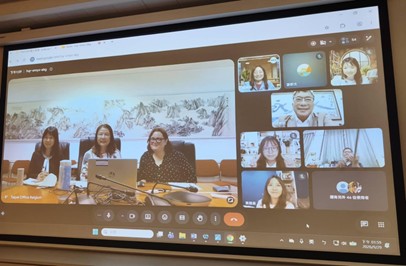
Since October 2024, the Education Division of the Taipei Representative Office in the EU and Belgium has been working with the General Administration of Education of the French Community of Belgium to promote courses on Taiwanese Culture. The courses cover a wide range of topics, including Taiwan’s geography; natural ecology; traditional festivals; architecture; transportation; food and cuisine; folk beliefs; traditional crafts, and greetings and numbers in Mandarin language. They make use of maps, photographs, videos, stories, games, cross-cultural comparisons, and hands-on activities to help the students learn about Taiwan.
The schools expressed strong interest in exchanges and interaction with primary and secondary schools in Taiwan. In response, the Education Division, Taiwan’s K–12 Education Administration, Taiwan’s Ministry of Education Primary and Secondary School International Educational Exchange Alliance, worked together with the Department of Compulsory Education and Wallonie-Bruxelles International of the French Community of Belgium to organize an international online exchange held on September 29, 2026.
Twenty-three schools located in cities in different parts of Taiwan—eleven secondary schools, and twelve primary schools—and nine secondary schools, and five primary schools located in several cities in Belgium’s French-speaking Community took part.
The eleven secondary schools in Taiwan were: • Caotun Junior High School in Nantou County; • Chien-Kuo Junior High School in Taoyuan City; • Chung-Li Junior High School in Taoyuan City; • Chunglun Junior High School in Kaohsiung City; • the junior high school division of Kaohsiung Municipal Jhong Jheng High School in Kaohsiung City; • Liantan Junior High School in Tainan City; • Ling Ya Junior High School in Kaohsiung City; • Makung Junior High School in Penghu County; • the Junior High Division of Tzu Chi Senior High School Affiliated with Tzu Chi University; • Wen Chang Junior High School in Taoyuan City; and • the junior high school division of Wun Shan Senior High School in Kaohsiung City.
The twelve primary schools in Taiwan were: • Dongguang Elementary School in Kaohsiung City; • Guanghua Elementary School in Nantou City; • Kaohsiung Municipal CianJhen District Ruei Siang Primary School in Kaohsiung City; • Nan-Shi Elementary School in Taoyuan City; • Qingpu Elementary School in Taoyuan City; • Sankuang Elementary School in New Taipei City. • Shalun Elementary School in Banqiao District, New Taipei City; • ShuangXi Elementary School in New Taipei City; • Tainan Municipal Liantan Elementary School in Tainan City; • Wulin Elementary School in Kaohsiung City: • Wunsian Elementary School in Tainan City; and • Xinrong Elementary School in Taoyuan City;
The nine participating secondary schools in Belgium’s French-speaking Community were: • Athénée Royal Paul Delvaux, in Ottignies; • Athénée Royal d’Ath, in Ath; • Collège Pie X, in Châtelineau: • Collège Sainte-Véronique, in Liège; • Communauté éducative Saint-Jean-Baptiste, in Sambreville; • Institut Saint-François de Sales, in Ath; • Institut de la Providence de Champion, in Namur; • La Cité École Vivante, in Liège; and • L’Institut Jean Jaurès, in Charleroi.
The five participating primary schools were: • Ecole fondamentale Émile André, in Brussels; • École Primaire de l'Allée Verte, in Brussels; • École primaire de Heembeek, in Brussels; • L'école primaire des Six-Jetons, in Brussels; and • the Marche-en-Famenne campus of the primary school of the Athénée Royal Marche-Barvaux-Bomal public school network, in Marche-en-Famenne.
The schools each gave a two-minute presentation introducing itself during the online exchange. Each school in Belgium will be matched with one or more of the schools in Taiwan and they will work together exploring themes related to A Day at a Primary (or Secondary) School in Taiwan and Belgium. The students will produce three-minute videos or posters about their daily school experiences, including how they travel to school, their breakfast and lunch customs, class schedules, school uniforms, and after-school activities. Other topics can include What’s in My Schoolbag?, distinctive features of teaching and learning in each school system, local foods, festivals and cultural traditions, traditional architecture, and religious customs in Taiwan and Belgium. The schools can also consider establishing sister-school relationships and long-term cooperation.
This online exchange was the first major bilateral exchange between primary and secondary schools in Taiwan and Belgium. It represents an important enhancing of international education-related cooperation that will broaden the students’ international perspectives.