The 2026 7th Taiwan Science Festival Launches: Sharing Science, Launching Sustainability
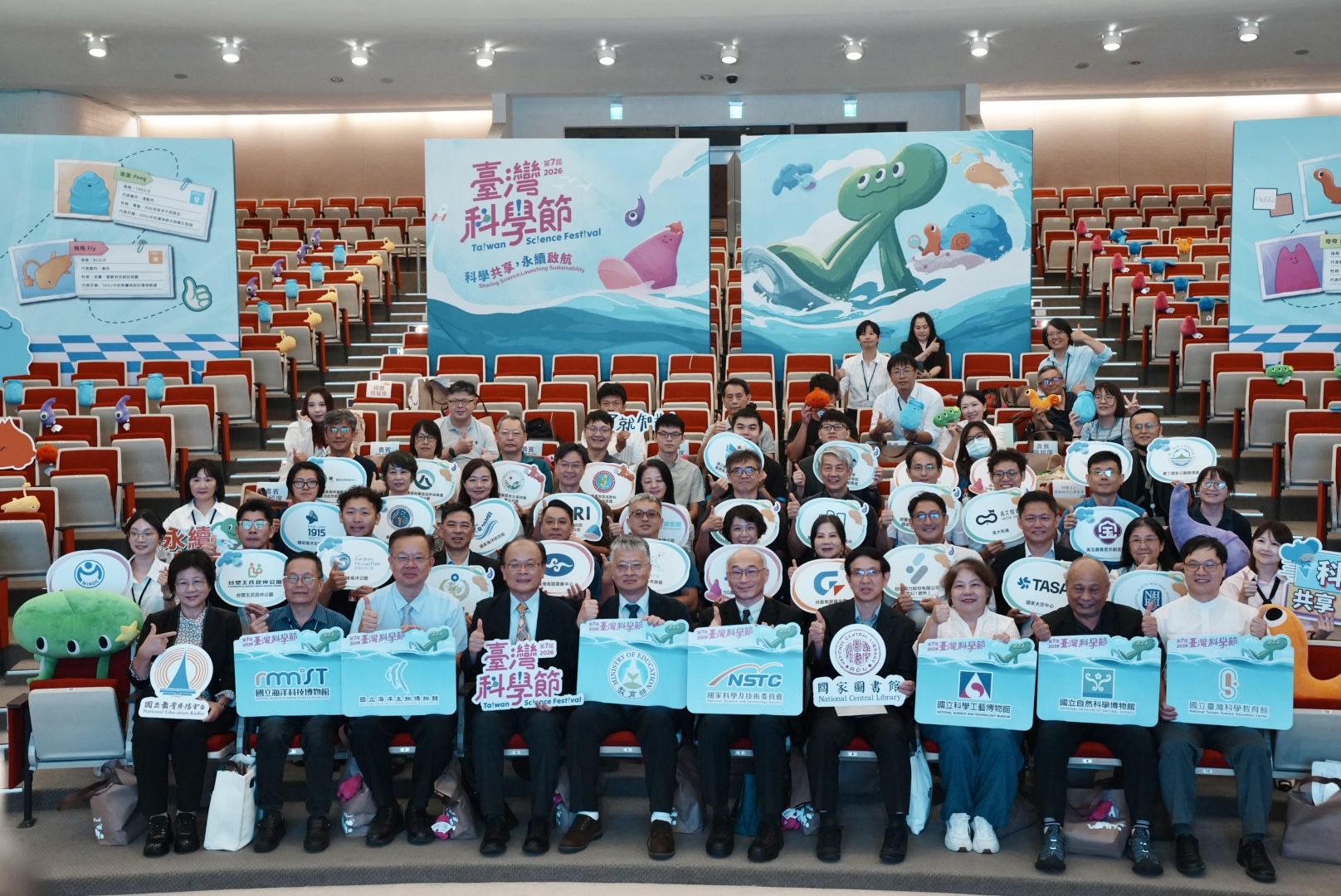
The Ministry of Education (MOE) held a press conference on 15 October to launch the 2026 7th Taiwan Science Festival. Political Deputy Minister Kuo-Wei Lui, Deputy Director-General Chi-Kang Kung of the National Science and Technology Council, the directors of the five major science museums and representatives from 34 popular science education bases jointly announced that the festival would take place over two weekends, on 7–8 and 14–15 November. With more than 2,000 popular science events planned, the festival invites everyone to join in this celebration of science.
Under this year’s theme, “Sharing Science, Launching Sustainability,” during the science festival the five museums under the MOE will present themed traveling exhibitions and related activities. Five modular exhibitions will open in succession including the “Exploring the Poles” special exhibition at the National Museum of Marine Science and Technology; the “Wonder · Play” special exhibition at the National Taiwan Science Education Center; the “Shifting Edges – wetlands in the Taiwan special exhibition at the National Museum of Natural Science; the “Climate Ark Sets Sail: A New Chapter for a Net-Zero Future” at the National Science and Technology Museum; and the “Ocean Share LAB” special exhibition at the National Museum of Marine Biology and Aquarium. The five exhibitions will subsequently tour the Taiwan, giving people across the country the opportunity to explore a range of sustainability issues. Through these exhibitions, the museums will incorporate sustainability principles into their exhibition activities.
In addition to the popular science exhibitions and performances staged by the MOE’s five major science museums, this year’s festival will expand its scope by partnering with 34 popular science education bases. A total of 2,063 activities are planned, comprising 12 forums and seminars, 46 theatrical performances, 800 science demonstrations, 600 exhibitions and film festivals, 60 science competitions, 131 workshops, 102 science fairs, and 312 other events at the popular science education bases. Highlights from the five major science museums are as follows:
1. The National Museum of Marine Science and Technology | Ocean Fantasy Adventure . Real-World Puzzle-Solving
The children’s Peking opera Juanjuan the Seahorse Who Couldn’t Fit In, performed by the Jingju Opera Troupe of the National Taiwan College of Performing Arts, uses a story set in an underwater world to encourage reflection on marine pollution. The Alternate Reality Game Puzzle Challenge combines exhibition exploration with puzzle-solving, helping participants gain a deeper understanding of marine knowledge and the stories of marine industries.
2. The National Taiwan Science Education Center | Science Takes the Stage . People in Science . 70 Years of Science Education Memories
The Science Demonstration Challenge invites young people to form teams and devise science demonstrations, turning abstract scientific principles into onstage challenges. The stage play Nikola Tesla traces his exploration of alternating current and wireless energy, giving audiences an understanding of his scientific ambitions and technological development. Marking the Center’s 70th anniversary, the stage production Foucault Pendulum takes audiences on a journey through time from the perspectives of three generations of one family, tracing the development of science education in the Taiwan.
3. The National Museum of Natural Science | Large-Scale Science Demonstrations . Extended Reality (XR) . Indigenous Wisdom
The Mad Science Show uses large-scale teaching aids and theatrical performances to transform concepts of mechanics and chemistry into highly interactive experiences. Captain XR’s Expedition creates an immersive science and art theater experience that blends physical and virtual worlds. The Indigenous Ecological Knowledge Science Play combines various forms of puppetry to showcase indigenous wisdom in food and agriculture, ecology and architecture.
4. The National Science and Technology Museum | Traditional Sounds . The Science of Electricity . Hands-On Technology
The Bunun Latuk Demonstration combines traditional culture with string resonance to explain the scientific principles of sound. The Popular Science Fair offers hands-on interactive experiences in science and technology. The Street Power Company uses everyday objects and experiments to promote understanding of electricity generation, electricity use and energy conservation.
5. The National Museum of Marine Biology and Aquarium | Ocean Theater . Silent Disco . Ocean Cinema
The Ocean Interactive Theater brings Hengchun’s local culture and sustainability concepts to the stage. The Silent Disco combines ocean soundscapes with aquarium display tanks to create a cross-disciplinary music party experience, with participants wearing headphones. The Ocean Temple Cinema presents ocean-themed films, with pre- and post-screening talks to promote knowledge of sustainability.
This year, the MOE has extended its invitation to more public and private science research institutions to join the popular science education bases, bringing together 34 participating organizations across the Taiwan. During the festival, these bases will host a wide range of popular science events nationwide. The public is encouraged to visit the official website for event schedules and details and how to take part in nearby activities. Representative popular science education bases across the Taiwan include:
● North: Taiwan Space Agency, National Taiwan University Museums and Xpark.
● Central: National Health Research Institutes and the Biodiversity Research Institute, Ministry of Agriculture.
● South: Southern Region Weather Center, Central Weather Administration, Metal Industries Research & Development Center, and Hengchun Cultural Center.
● East: Farglory Ocean Park.
This year, the festival’s official Facebook and Instagram accounts are also running a series of promotional campaigns, keeping the public up to date with the latest news and offering exclusive interactive activities. In addition to gifts provided through brand partnerships and sponsorships, participants have the chance to win special prizes, including a festival-exclusive 2027 Ig Nobel Prize desk calendar and TaBi LoBi Squad bath bomb blind boxes, offering the public a new way to enjoy learning about science.
● Event information: https://tsf.moe.edu.tw/
● About the popular science education bases: https://tsf.moe.edu.tw/science
● Official Facebook page: https://www.facebook.com/taiwansciencefestival/
● Official Instagram account: https://www.instagram.com/sciencefest.tw