Taipei Representative Office in the EU and Belgium & KU Leuven Hold a Calligraphy Workshop to Promote Taiwanese Culture and Scholarships



The Taipei Representative Office in the EU and Belgium has been collaborating with KU Leuven for many years assisting it to offer Chinese language courses at its Brussels campus. They continue to explore innovative ways to attract students and enrich their language learning experience, and encourage more engagement with Taiwan. To enhance students’ understanding of East Asian culture and Taiwan’s education landscape, the Education Division and KU Leuven organized a Chinese calligraphy workshop held on February 12, 2026, as part of a Multilingual and Cultural Week series of events to celebrate the university's 600th anniversary.
The workshop attracted a wide range of students. Many were students of Asian studies, linguistics, and international relations; others were students who were simply curious about Chinese characters and East Asian culture.
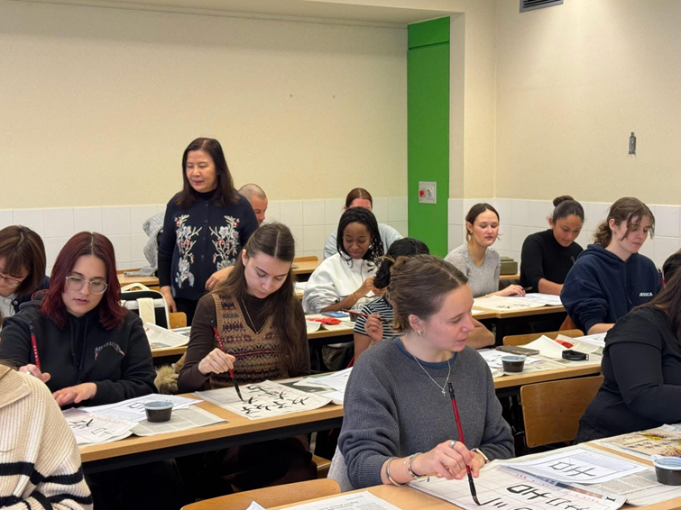
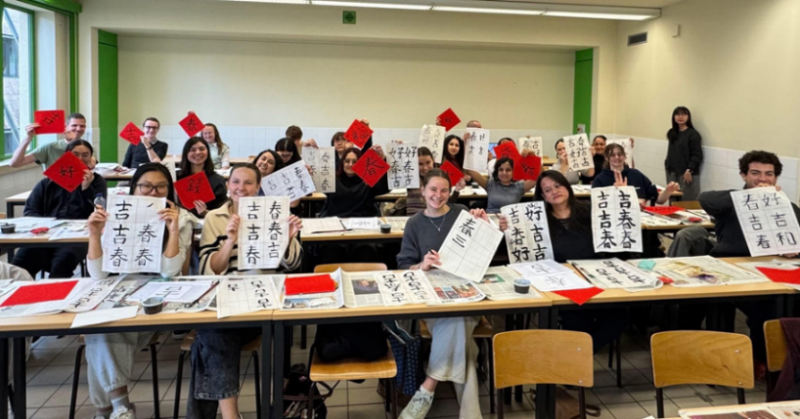
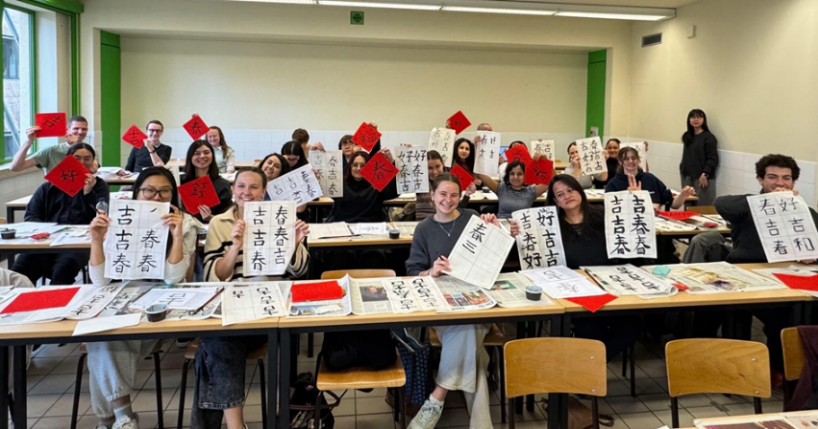
The Education Division invited two Mandarin teachers to guide the students through the very hands-on workshop. They began by explaining the basic structure and stroke order of Chinese characters and then demonstrated how to hold and control the brush and apply the ink to the paper. They also explained the meanings and significance of the characters that the students then enjoyed practicing writing, and could later take home: for example, auspicious characters such as “吉” (good fortune) and short phrases commonly seen displayed during the Lunar New Year.
As well as the calligraphy, the workshop featured a hands-on introduction to traditional paper-cutting. The teachers explained the symbolism behind common motifs—such as flowers, animals, and geometric patterns—and guided the students through each step of cutting them out to make their own designs. This was the first time that many of the students had ever tried this traditional art form.
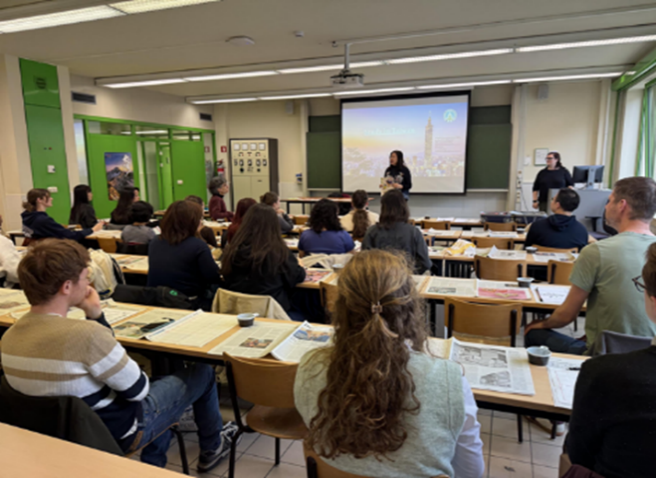
During the workshop, Dr. Nicole Yen-Yi Lee, the Director of the Education Division, gave the students details about possibilities for studying in Taiwan, including programs taught in English, and scholarships such as the Taiwan Scholarships for degree courses, and the Huayu Enrichment Scholarships to study Mandarin in Taiwan, and living conditions there. The students asked many questions about Taiwan-related matters, such as student life there, safety, and opportunities for academic exchanges.
The workshop was a great success with its interactive nature and friendly atmosphere. The students expressed delight as they wrote Chinese characters with a brush and made traditional paper-cuts, at the same time as being able to appreciate the cultural meanings behind them. More students might now consider learning Mandarin and consider Taiwan as a further study destination.